

Client: Google
Product: Google Pixel Studio
Timeline: 9 weeks (Spring 2025)
Role: Consultant (Research, Strategy, Design Insight)

Consulted for Google Pixel Studio; an AI image generation app, conducting end-to-end UX research across 3 SMB verticals (90+ surveys, 15+ interviews) and competitive benchmarking (DALL·E, Canva, Midjourney) to deliver product-market fit insights and propose UI/UX features around efficiency, hyper-personalization, and trust
PROBLEM FRAMING
Google Pixel Studio is an AI-powered image generation tool aimed at small businesses, but adoption and differentiation in a crowded AI market (DALL·E, Midjourney, Canva AI) remained unclear. We framed this as both a market opportunity problem and a product-market fit problem.
-
How do small businesses perceive, trust, and use AI-generated imagery?
-
Which business verticals present the strongest growth opportunity?
-
How can Pixel Studio be positioned and improved to better fit real workflows?
Before collecting data, we formed initial hypotheses:
-
AI image tools succeed when they enhance real content, not replace it
-
Trust is the primary barrier to AI adoption for small businesses
-
Different verticals (Creative, Education, Restaurants) have fundamentally different needs
RESEARCH
A. Quantitative Research (Surveys)
We surveyed 90 small business owners and consumers to understand broader patterns around AI awareness, trust in AI-generated marketing content, perceived ability to distinguish AI from real images, and visual style preferences across different industries.
The survey allowed us to benchmark Google Pixel Studio against key competitors such as DALL·E, Canva AI, and Midjourney, while also testing how AI usage impacts consumer trust and engagement at scale.

A. Qualitative Research (Interviews)
To complement this quantitative data, we conducted 15 in-depth, one-on-one interviews with small business owners across three fast-growing verticals: Creative, Education, and Restaurants.
During these sessions, participants actively interacted with Google Pixel Studio, enabling us to observe real-time reactions, moments of confusion or delight, and gaps between intended and actual workflows. See the form we used to track the interviews below.
Together, the surveys and interviews allowed us to triangulate findings, validating broad trends while uncovering actionable, human-centered insights to inform Pixel Studio’s product strategy
DATA SYNTHESIS & ANALYSIS
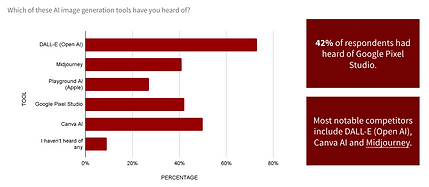
-
Majority of respondents reported lower trust when ads used fully AI-generated images
-
Yet, users believed they could spot AI, even when they often couldn’t


-
Creatives: wanted brand consistency & style memory
-
Educators: needed accurate, editable text and instructional visuals
-
Restaurants: wanted to remix existing photos, not generate new ones


RECOMMENDATIONS
-
A built-in branding assistant that:
-
Learns brand style over time
-
Flags off-brand outputs
-
Applies consistent aesthetics automatically
-

-
Real, editable text generation
-
Voice-to-text overlays
-
Grade-level presets
-
Re-editing workflows instead of restarting


-
Edit existing photos
-
Swap backgrounds, lighting, seasonal elements
-
Export across platforms instantly

FINAL DELIVERABLE

Our team delivered a comprehensive strategic presentation to Google at their HQ in Mountain View synthesizing research insights into clear, actionable recommendations. We presented in front of the Google Pixel Team, both on zoom and in person.
As a result, the engagement helped the Google Pixel Studio Team identify trust as the primary barrier to adoption for small businesses using AI generated imagery. Our recommendations repositioned Google Pixel Studio as a workflow enhancer rather than an AI novelty, providing a product roadmap aligned with how small businesses actually create, adapt, and market content in practice.
This was my second consulting project, this time with a larger scale client. While I felt that it can be harder to see immediate outcomes at Google’s scale, it was motivating to work on a product with the potential to meaningfully improve small businesses’ daily workflows. The experience reinforced my interest in building human-centered products, solving real world needs, that ultimately create real value when deployed at scale.